From the blog
CBD E-commerce Website Compliance CMS: Why 24-Hour Copy Edits Decide Who Stays Online

If you are in CBD, you have heard the advice: just use Shopify. Shopify is great until your payment processor reads your product copy. Then it is 6:47pm Thursday, your acquirer is asking why a tincture PDP promises to treat anxiety, and the only person who can edit the page is on a plane somewhere over Denver.
That is the moment most founders learn what a CBD e-commerce website compliance CMS actually has to do. It is not a theme. It is not a page builder. It is a content operation that can pivot product copy across 200 SKUs in 24 hours, host a per-batch Certificate of Analysis next to every product, and prove the edit shipped on a timestamp your processor will accept. The FDA, your acquirer, and the state attorneys general do not wait for your next sprint planning meeting.
This post is for hemp founders who are evaluating either a new platform, a new CBD web design agency, or both - and want to know what the actual day-two operating model has to look like once a real compliance event hits the catalog. Book a 20-minute compliance walkthrough with the Workspace CMS team.
The compliance whiplash that breaks normal CMSes
Here is the pattern every hemp operator has watched at least twice. The FDA posts a warning letter Tuesday afternoon. The letter calls out a specific phrase - a structure/function claim that has crossed into disease-claim territory, or copy implying a cannabinoid is GRAS for ingestion when no NDIN is on file. By Wednesday morning, every compliance consultant in the category has emailed clients a screenshot and a 72-hour deadline. By Friday, payment processors and ad networks have flagged the exact wording across hundreds of catalogs.
If your site is on a stack where copy edits require a developer ticket, a staging environment, and a Tuesday-next-week deploy window, you are the brand still showing the phrase on Monday. Your processor sees it. Your MID gets a hold. Authorize.net stops capturing. Your Klaviyo flows fire, but checkout is dead. Customer service inboxes fill with refund requests you cannot process because the gateway is frozen, which becomes its own chargeback wave forty days later.
The CMS question is not about themes. It is: how fast can a non-developer ship a copy change across every product page that contains a specific phrase, and prove it shipped? If the answer is more than 24 hours, you do not have a compliance CMS. You have a liability with a credit-card form attached.
What a CBD e-commerce website compliance CMS actually owns
In our experience with hemp brands doing seven and eight figures, the day-to-day content surface has four non-negotiable pieces. Most platforms handle one or two. A real CBD-ready CMS owns all four, and the full Workspace CMS feature inventory is built around exactly this operating reality.
1. Same-day product-copy pivots across the full catalog
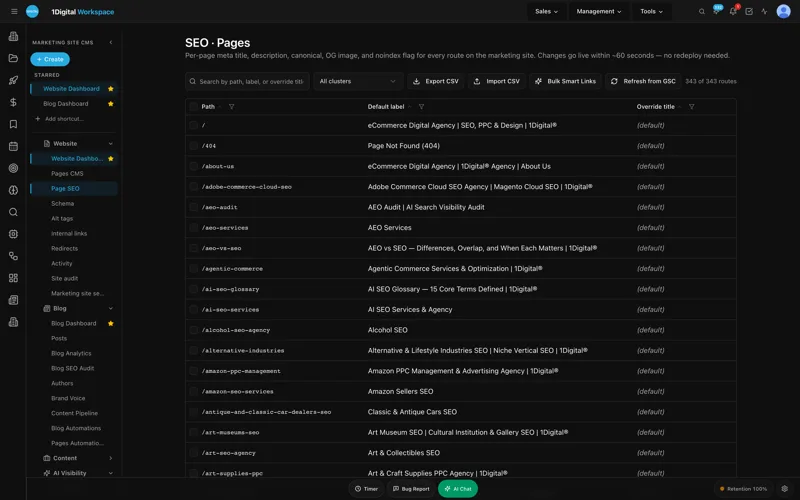
You need to send one ticket - strip "clinically proven to reduce inflammation" from every full-spectrum tincture PDP and replace with the approved structure/function variant- and have it live before the next ACH settlement window. No page-builder fighting. No staging branch. The Page Editor with permanent SEO Sidebar is what makes that workflow auditable: a compliance editor can scan title, meta, structured-data fields, and body copy on one screen without bouncing between four tools. The Workspace CMS promise is literal: send a ticket; we ship the change. For CBD that is not marketing. It is what keeps the merchant account open.
2. Per-batch COA hosting wired to the PDP
Every batch needs its own COA page - cannabinoid profile, pesticide screen, heavy metals, microbials, residual solvents - and the product page has to link to the COA for the specific batch the customer is buying. Static PDFs in a Drive folder will not survive a state inspection or a chargeback dispute. You need structured COA pages with JSON-LD product schema, batch IDs in the URL, and a Redirect Manager with 301/302/307/308 support and conflict detection that handles batch sunsetting without 404ing the QR codes already printed on bottles in customers' hands.
3. State-shipping eligibility tables that update overnight
Delta-8 in Oregon is not delta-8 in Idaho. Delta-9 in Minnesota is not delta-9 in Iowa. THCA flower legality flips on a Farm Bill amendment vote. A real CBD CMS gives you a structured table - state, product class, ship/no-ship, effective date, citation - that renders into a customer-facing policy page and into the checkout's shipping rules. The Multi-Location Storefront module is the same architecture brands use for store locators, repurposed here to drive state-eligibility lookups with ZIP search and structured data per jurisdiction. When Tennessee changes its rules Wednesday, the table changes Wednesday night.
4. An age gate that is auditable, not decorative
Every age gate looks the same to a 14-year-old with a mouse. The difference between a defensible gate and a cosmetic one is the audit log: who set the threshold, when it changed, what the cookie TTL is, which jurisdictions it enforces. Per-Tenant Isolation with RBAC and a full audit log is the document trail your compliance counsel will subpoena from you when something goes sideways. Owner / Editor / Viewer roles, white-label admin, every change timestamped - this is the boring infrastructure that wins a processor review.
UNLIMITED MANAGED CHANGES
Send a ticket. We ship the change.
Every Workspace CMS plan includes unlimited managed CMS edits. Essentials ships in 4 business days. Growth ships in 2. Premium ships in 12–24 hours. No per-edit fees. No “open a Jira” overhead. Every compliance copy edit, every COA refresh, every state-shipping table update - describe what you need and our team builds it on your live site.
Choosing a CBD web design agency that survives day two
Most hemp brands hire an agency for a launch. The launch goes fine. Then day 31 arrives, the first compliance event hits, and the agency is on a different retainer working on a wedding photographer's site. This is the failure mode founders need to underwrite against when they are picking a CBD web design agency: not what they build, but what they ship on day 31, day 92, and day 187.
A hemp brand website company that lasts is one whose operating model is the same as its launch model: a ticket queue, a managed-change SLA, and a public managed-change workflow that names who does what and how fast. If the proposal you are reading does not include an SLA expressed in business hours, you are buying a launch, not a partnership. There is no clean exit from that mistake at month six - your catalog is already in their stack and the migration cost is the pricing weapon they hold over you.
The other thing to underwrite: does the agency understand compliance copy at all? A general DTC studio that has never read a warning letter will write a beautiful PDP that lights up a processor review the day Stripe Climate refreshes its prohibited-content list. A CBD-literate CBD website designer writes copy a compliance attorney has already pre-reviewed, in structure/function language counsel signs off on, and rebuilds the same templates whenever the rules shift.
The tier question: where do CBD brands actually land?
Workspace CMS publishes three tiers, and the honest answer for a serious hemp operator is that only one works once you cross a million in revenue.
- Essentials at $89/month is self-managed with a 4-business-day SLA on managed changes. Fine for a pre-launch single-SKU brand. Not fine when a warning letter drops Tuesday and you need the copy gone by Wednesday.
- Growth at $199/month is the common pick for general DTC. Same-business-day SLA on blockers, 2-business-day on standard edits, Google reviews on your site (display and reply), white-label admin. Right floor for a non-regulated category.
- Premium at $449/month is the floor for any CBD brand doing seven-figure revenue. The 12-to-24 hour change SLA and 4 business-hour blocker SLA are the only tier that survives the compliance-whiplash cycle. The daily AI Site Audit catches phrasing drift before your processor does. Daily AI Site Audit + LLM visibility digests catch when a structure/function claim accidentally lands back in a top-of-funnel post.
Model Premium against the cost of one MID freeze. Industry averages put a 30-day processor hold at roughly $40,000 to $80,000 in deferred revenue for a brand in the $2M-$5M range, plus the reserve the processor will require to release future captures. A single processor hold pays for Premium for a decade. Compare the tiers against a regulated catalog.
The SEO and AEO surface CBD brands ignore
Compliance is the floor. Discovery is the ceiling. Hemp brands lose Google rankings to compliance-friendly aggregators every quarter, and they are now losing ChatGPT, Claude, Perplexity, and Gemini citations to those same aggregators because nobody is editing structured data on the brand side. The Rich Search Results editor deep-dive walks through what a brand-side editing surface looks like at scale.
Levers that move a hemp catalog:
- Structured Data (JSON-LD) Editor with cannabinoid fields, batch identifiers, and COA URLs - templated per product class so new SKUs inherit the right schema, with live validation before publish.
- Site Audit with 40+ checks per page and one-click remediation - catches missing alt tags, broken canonicals, schema errors, and the structural issues that quietly suppress PDPs from index.
- AI Content Audit tuned to flag structure/function language and disease-claim drift across the existing catalog, with one-click rewrite suggestions a compliance editor can approve or edit.
- Automations that schedule the COA refresh sweep, the monthly alt-tag pass, the recurring claim-language scan, and the weekly AI-visibility digest - so the work happens whether or not anyone remembers to queue it.
- llms.txt + robots.txt + auto-regenerated sitemap- you decide which AI crawlers index your COA pages. Most brands block the bots driving cited answers without realizing it.
- AI Visibility Tracker across ChatGPT, Claude, Perplexity, Gemini - 30 prompts on Premium, tracked weekly, so you can see when your brand stops being the cited source for “best full-spectrum CBD tincture.”

What launch looks like with a CBD-literate CMS partner
Most clients launch in two weeks. For a hemp catalog with 80 to 250 SKUs and a COA archive, expect closer to three. The team handles the migration off Shopify or BigCommerce, the redirect map, the JSON-LD templates, the age-gate setup, the state-shipping table, and the first sweep of structure/function language across the catalog. Real humans, real AI tools, real changes shipped fast. No page-builder fighting. No HTML required. Send a ticket; we ship the change.
If you want to see the operating model in action before committing, the live demos gallery includes regulated-industry tenants running on the same stack, and the case-studies library documents what month-six looks like once the launch glow wears off and the first real compliance test arrives.
CBD E-commerce Website Compliance CMS: Why 24-Hour Copy FAQ
Does Workspace CMS handle age-gate and state-shipping logic out of the box?
Yes. The age gate is a configurable component with role-restricted edit access and a full audit log. State-shipping eligibility is a structured table the team maintains - send the citation and effective date, and the table flips on schedule. Policy page and checkout rules read from the same source.
How do per-batch COAs work on the product page?
Each batch gets its own URL with structured product data: cannabinoid breakdown, batch ID, harvest and test dates, lab citation. The PDP links to the active batch by default and the Redirect Manager handles the redirect chain when a batch sunsets, so QR codes printed on bottles in the wild keep resolving.
What happens when an FDA warning letter forces a 72-hour copy change?
On Premium, you send one ticket with the phrase that has to go and the replacement language counsel approved. We ship the edit across PDPs, posts, category descriptions, and alt tags inside the 12-to-24 hour SLA, with an audit-log entry your compliance team can hand to your processor.
Can you migrate our existing Shopify catalog and COA archive?
Yes. Migration is part of the launch scope. We import the catalog, build the redirect map, ingest the COA archive into structured pages, and rebuild JSON-LD per product class. Most brands are live in two to three weeks.
What is the realistic monthly cost for a serious hemp brand?
Premium at $449 per month is the floor for any CBD operator doing seven-figure revenue. Brands at Essentials or Growth graduate to Premium the first time they sit through a processor freeze. Compared to the cost of a 30-day MID hold, the math is not close.
The bottom line
CBD operators who stay online are not the ones with the prettiest themes. They are the ones whose CMS can pivot product copy in 24 hours, host a defensible COA archive, and produce an audit log on demand. Everything else is decoration. Pick the platform and the CBD marketing agency partner whose day-31 operating model already assumes the warning letter is coming - because it is.
Start a strategy conversation with the Workspace CMS team and see what a 12-to-24-hour SLA looks like on a 200-SKU hemp catalog.


