From the blog
How to Find the Right CBD Dosage for Your Needs
The right CBD dosage depends on your body weight, the condition you're addressing, your individual metabolism, and the product's concentration. Most adults start between 10–25 mg of CBD per day and adjust upward in 5 mg increments every 3–7 days until they reach their target effect. There is no universal dose, but a structured approach gets you there faster.
CBD (cannabidiol) has moved firmly into mainstream wellness, but dosage remains the single biggest point of confusion for new users. Manufacturers can't legally prescribe dosages on labels in most jurisdictions, which leaves people guessing. This guide cuts through that ambiguity with a practical, evidence-informed framework.
Why There's No Single "Correct" CBD Dose
CBD interacts with the endocannabinoid system (ECS), a regulatory network that varies significantly between individuals. Factors that directly influence how much CBD you need include:
- Body weight: Heavier individuals generally require higher doses to achieve the same effect.
- Metabolism speed: Fast metabolizers process CBD quickly, reducing its effective window.
- Condition severity: Mild stress requires far less CBD than chronic pain or sleep disorders.
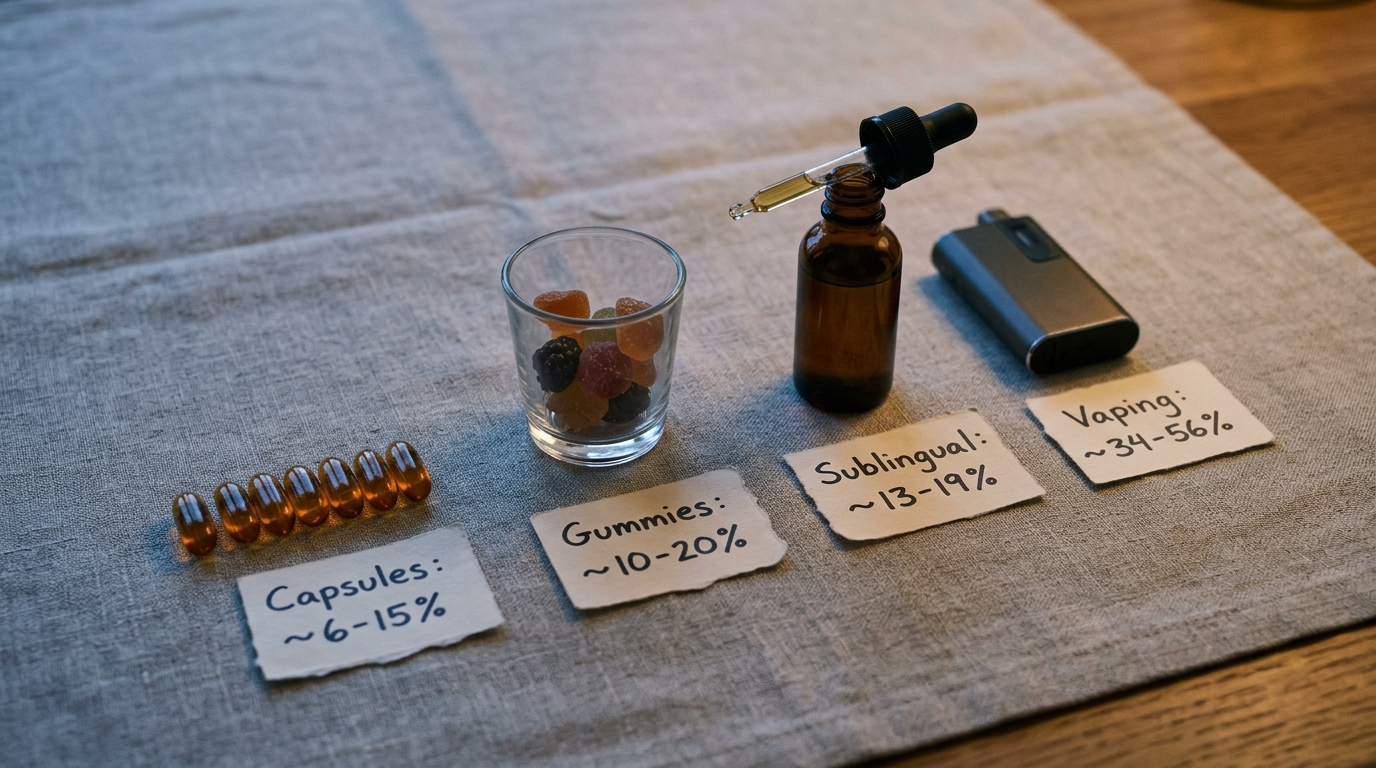
- Delivery method: Sublingual oils absorb at 20–35% bioavailability; edibles absorb at 6–19%; vaping reaches 34–56%.
- Tolerance: Regular users often need higher doses over time as their ECS adapts.
- Medications: CBD inhibits cytochrome P450 enzymes, which can affect how other drugs metabolize. Always consult a physician if you take prescription medications.
The General Dosage Framework: Start Low, Go Slow
The phrase "start low, go slow" is not just a platitude - it's the most reliable method for finding your minimum effective dose without wasting product or experiencing side effects like drowsiness or digestive upset.
- Start at 10–15 mg per day for one full week. Take it at the same time each day for consistency.
- Evaluate honestly. Are you noticing any change in the target symptom? Rate it on a simple 1–10 scale each morning.
- Increase by 5 mg if you see no improvement after 5–7 days.
- Continue stepping up in 5 mg increments weekly until you notice benefit, reach 100 mg/day, or experience unwanted side effects.
- Lock in your dose once you find the minimum amount that produces consistent results, and stay there for at least 30 days before re-evaluating.
Dosage by Body Weight: A Starting Reference
Many practitioners use a weight-based starting formula of 1–6 mg of CBD per 10 lbs (4.5 kg) of body weight, depending on condition severity. The table below gives practical starting ranges:
- Under 130 lbs (59 kg): Low severity - 11 mg | Moderate - 15 mg | High severity - 17 mg
- 130–230 lbs (59–104 kg): Low severity - 18 mg | Moderate - 23 mg | High severity - 27 mg
- Over 230 lbs (104 kg): Low severity - 22 mg | Moderate - 30 mg | High severity - 45 mg
These are starting points, not ceilings. Clinical research on CBD - including the FDA-approved epilepsy drug Epidiolex, which uses doses up to 20 mg/kg/day - confirms that CBD has a wide safety margin at higher doses, though everyday wellness use rarely requires that level.
Dosage by Condition: What the Research Suggests
Different conditions correspond to different effective dose ranges based on available clinical and observational data:
- General wellness and stress: 10–30 mg/day
- Anxiety and mood support: 25–75 mg/day (a 2019 study in The Permanente Journal found 79% of patients reported reduced anxiety scores using 25 mg/day)
- Sleep difficulties: 25–150 mg taken 30–60 minutes before bed
- Chronic pain and inflammation: 15–50 mg/day; some patients report needing 100+ mg for severe conditions
- Neurological conditions (under medical supervision): Up to 600 mg/day in research settings
Delivery Methods Compared: How Format Changes Your Effective Dose
The same milligram amount produces very different effects depending on how you consume CBD. Here is a direct comparison:
- Sublingual oil/tinctures: Bioavailability 20–35% | Onset 15–45 minutes | Duration 4–6 hours | Best for: Precise dosing, daily maintenance
- Capsules and softgels: Bioavailability 6–19% | Onset 30–90 minutes | Duration 6–8 hours | Best for: Consistent routine, travel
- Edibles and gummies: Bioavailability 6–19% | Onset 45–120 minutes | Duration 6–8 hours | Best for: Discreet use, palatability
- Vaping and inhalation: Bioavailability 34–56% | Onset 2–5 minutes | Duration 2–3 hours | Best for: Acute relief, fast onset
- Topicals: Minimal systemic absorption | Onset 15–45 minutes | Duration 4–6 hours | Best for: Localized pain, skin conditions
If you switch delivery methods, recalibrate your dose from scratch. A 25 mg edible does not produce the same effect as a 25 mg sublingual dose - the sublingual delivers significantly more CBD to your bloodstream.
How to Read CBD Product Labels Accurately
One of the most common dosing errors comes from misreading labels. A bottle that says "1000 mg CBD" contains that amount across the entire bottle, not per serving. If the bottle holds 30 mL and each 1 mL dropper holds roughly 33 mg of CBD, each full dropper is your per-dose unit.
Always look for:
- Total CBD mg per bottle (e.g., 1500 mg)
- Serving size volume (e.g., 1 mL)
- CBD per serving (calculated: total ÷ number of servings)
- Third-party Certificate of Analysis (COA) confirming actual cannabinoid content
Reputable brands publish their COAs from independent labs like ProVerde, Eurofins, or SC Labs. If a brand won't provide one, don't buy from them.
Tracking Your Progress: The CBD Journal Method
Systematic tracking is the fastest path to your optimal dose. Keep a simple daily log with:
- Date and time of dose
- Exact dose in milligrams
- Product and brand used
- Target symptom rating (1–10 before and after)
- Side effects, if any
- Sleep quality and mood notes
After 4 weeks of consistent logging, patterns emerge clearly. You'll see exactly which dose level correlates with your best symptom scores - and that number becomes your personal baseline.
Potential Side Effects That Signal You've Gone Too High
CBD is well-tolerated by most adults, but exceeding your optimal dose produces recognizable signals:
- Fatigue or excessive drowsiness
- Diarrhea or digestive discomfort
- Dry mouth
- Changes in appetite
- Lightheadedness, especially when standing
If any of these occur, reduce your dose by 5–10 mg and hold steady for another week. Side effects almost always resolve within 24–48 hours of reducing the dose.
When to Involve a Doctor
Consult a physician before starting CBD if you take blood thinners (warfarin), antiepileptic drugs, immunosuppressants, or any medication with a narrow therapeutic window. CBD's inhibition of cytochrome P450 enzymes can raise the plasma concentration of these drugs to potentially dangerous levels. This is not a hypothetical risk - it's a pharmacological reality documented in Epidiolex's clinical trial data.
What is the best starting dose of CBD for a beginner?
Most beginners do well starting at 10–15 mg of CBD per day, taken consistently at the same time. Hold that dose for one week, evaluate your results, and increase by 5 mg if needed. This approach finds your minimum effective dose with the lowest risk of side effects.
How long does it take for CBD to work?
Onset time depends on the delivery method. Sublingual oils work in 15–45 minutes. Edibles and capsules take 45–120 minutes. Vaping produces effects in 2–5 minutes. Consistent daily use over 2–4 weeks often produces more stable, noticeable results than single doses.
Can you take too much CBD?
CBD has a high safety ceiling. Studies have administered doses up to 1500 mg/day without serious adverse events in adults. However, exceeding your personal optimal dose causes fatigue, digestive issues, and drowsiness. "More" does not mean "better" - the goal is the lowest effective dose for your needs.
Does CBD dosage differ for anxiety versus pain?
Yes. Anxiety typically responds to 25–75 mg/day. Chronic pain often requires 15–100 mg/day depending on severity and delivery method. These ranges overlap, but pain management - especially neuropathic or inflammatory pain - generally demands higher doses than stress or mild mood support.
Should I take CBD once a day or split my dose?
Splitting your dose into two administrations - morning and evening - maintains more consistent CBD blood levels throughout the day and works better for chronic conditions like anxiety, inflammation, or sleep problems. A single dose works fine for targeted, acute relief. Start with once daily, then split if results are inconsistent.


